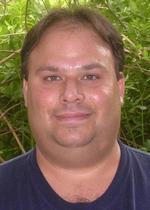
Fellow Profile: Victor Piercey
- G-TEAMS Cohort: 2009-10
- Graduate Program: Mathematics
- Teacher Partner: Connie Dolezal
- School: Casa Grande Union High School
- Grade level: 9-12
- Topics: Algebra 5/Trigonometry & AP Statistics
"As mathematicians, we can bring our experience and creativity into the classroom to help combat the declining mathematical skills of our high school graduates."
Research Interests
Victor’s research is in algebraic geometry, which can be described as the study of simultaneous solutions to polynomial equations. More precisely, algebraic geometers study spaces formed by patching together solutions to systems of polynomial equations, similar to the manner in which real manifolds are constructed by patching Euclidean spaces together. Victor’s area in algebraic geometry is moduli spaces. Sometimes, in algebraic geometry, a collection of spaces that have certain common invariants form a geometric space itself. Victor studies moduli spaces of configurations of points.
Classroom Activities
Victor has been working with Connie Dolezal at Casa Grande Union High School. Connie’s classes this year are Algebra 5/Trigonometry and A.P. Statistics. Victor’s goals for his classroom involvement include:
- bringing mathematics to life by couching his instruction in real life applications and activities when possible, including the use of end-of-the-year projects;
- engaging students in “mathematical thinking”;
- developing students’ problem solving abilities;
- identifying the source of student difficulties with mathematics; and
- learning how to communicate with a non-mathematical audience.
Victor has learned a great deal during his time in the classroom. For example, he has learned how to identify a single concept about which a lesson revolves, and how to read an audience to determine when to slow down, speed up, or even stop.
Lessons Learned
Students frequently don’t have trouble understanding a new concept. It becomes difficult when they have to use or integrate previous concepts in problem solving. They struggle with the cumulative nature of mathematics. It seems to me that this is the result of teaching for tests, such as AIMS. It is also a result of mental blocks that come up with certain topics, such as fractions, that they have trouble with when first encountered and never understand.
Worksheets get more students involved than the ordinary class discussions. It allows the teacher to work individually with students to expose and correct individual misconceptions. Several students who are ordinarily very quiet start asking a lot more questions.
Students don't know how to read mathematics at all. Reading mathematics is a skill that students are never taught. It isn't like reading any other subject. This should be addressed more in K-12 classrooms.
Bringing mathematics to life in the classroom really requires integrating the mathematics with applications. Most textbooks relegate applications to the end of a section, some problems at the end of a problem set which are often not assigned, or some section at the end of a chapter. Instead, students can work on an application and the new mathematics can be introduced when it is necessary to move forward.
Teaching Materials
- Handouts: worksheets given to a class to work on as part of a lesson.
- Algebra 5/Trigonometry
- Problem Solving Flowchart
- Functions and Function Notation
- Inverse Functions
- Challenging Problems Involving Quadratic Functions
- Polynomial Division
- Linear Factorization of Polynomials
- Exponential Functions
- Compound Interest
- Identities
- Sum and Difference Trig Identities
- The Law of Cosines and Real Estate
- The Law of Cosines and the Distance Between Two Stars
- Introduction to Polar Coordinates
- The Old Colony Trust Co. Case and Infinite Geometric Series
- Probability with M & M's
- Cryptography
- A.P. Statistics
- Algebra 5/Trigonometry
- Slides: slide presentations used for instruction.
- Algebra 5/Trigonometry
- A.P. Statistics
- Projects: end of the year projects designed for hands-on learning and further exploration and synthesis.