
Fellow Profile: Megan Alexander
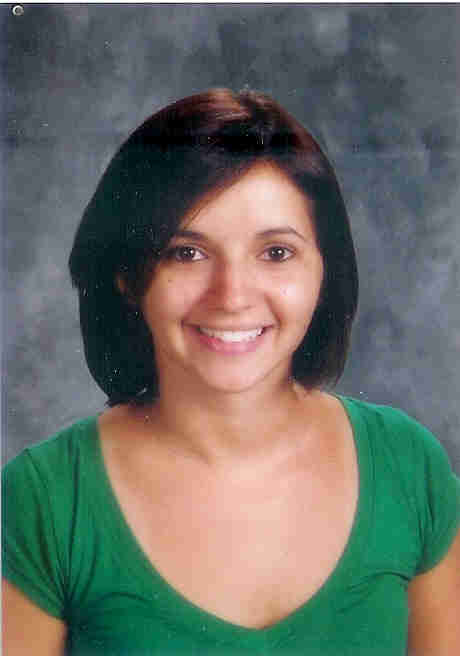
- G-TEAMS Cohort: 2010-11
- Graduate Program: Biomedical Engineering
- Teacher Partners: Kelley Brooks & Maggie Hackett
- School: Elvira Elementary School
- Grade level: 4
- Topics: Mathematics & Science
"If our society wants to produce more mathematicians, scientists, engineers, or anything likewise, we must focus on teaching the fundamentals and providing a passion for math in young students at the earliest time possible."
Research Interests
Megan’s research interest is nerve mechanics in the Soft Tissue Biomechanical Laboratory under Dr. Jonathan Vande Geest. More specifically she studies the biomechanical properties of the recurrent laryngeal nerve (nerve that innervates the larynx or voice box) in order to understand the idiopathic (of unknown cause) onset of Unilateral Vocal Fold Paralysis (UVP). By performing tensile testing on the RLN, she is able to characterize the ability of the RLN to resist stretching and compression and represent the behavior with a constitutive model. Understanding the biomechanical response of this nerve will allow a better understanding of the causes of idiopathic UVP.
Classroom Activities
Megan has been working with 4th grade teachers Kelley Brooks and Maggie Hacket at Elvira Elementary School. Megan’s goals for her classroom involvement include:
- Help students develop fluency in approaching mathematical problems.
- Teach students how to evaluate their solutions to mathematical problems.
- Develop communication among students about their mathematical work.
- Build student confidence by encouraging them and allowing them to have fun so that they do not become afraid of mathematics.
- Allowing students to enjoy and appreciate mathematics.
Lessons Learned
As a scientist and engineer, I believe that mathematics and science should be taught in conjunction. Before I became a G-TEAMS fellow I already knew that mathematics is a big problem area for many students because of my own educational experience in public schools. One of the things I hear from people every day, whether it’s from students, parents, friends, etc., is “I’m just not good at math”. This has become the reason many people don’t pursue careers in scientific and technological fields, or any other field that may require any math more advanced than college algebra.
This year I have particularly learned a lot from working in a Title 1 school. The basic principles of Title 1 state that schools with large concentrations of low-income students will receive supplemental funds to assist in meeting student’s educational goals. Every teacher faces the task of motivating students in their classroom. While some students enthusiastically walk into a classroom each day, others need motivation and inspiration to focus on school. Teachers in Title 1 schools encounter students facing life struggles many of us cannot even imagine. Encouraging these students to concentrate on school can be a daunting task. Often these students feel it is impossible to break the chain of events. They witness their parents following the same path as their grandparents, and think they are destined for the same journey. Many of these students know someone in jail, have used food stamps for purchases or have gone to bed hungry. At times, teachers of Title 1 students act as more than just teachers. They become a confidant when they need someone to talk to, a cheerleader for their achievements and a mentor when mom or dad isn’t available.
At a Title 1 school lesson plans must be focused on the state established guidelines to prepare students for state tests. In is often challenging to create creative, effective lessons that meet the needs of every student. Many students lack important background knowledge to make connections between class examples and their own lives. I have learned that it is important to work at building these student’s background knowledge. It is also very useful to connect with the students to determine what is most important to them. A lot of these students are missing support from home and I have learned that constant encouraging words are a must. Creating assignments that are manageable encourages confidence. Then, slowly increasing the difficulty as the year progresses provides the students with growing knowledge.
Teaching Materials
- Perimeter and Area (Power Point presentation)
- Probability and Combinations (Power Point presentation)
- Measurement
- Metric Mania: Mass (Power Point presentation)
- How much mass? (Lesson and worksheet - MS Word document)
- Metric Mania: Volume/Capacity (Power Point presentation)
- Instructions for capacity activity (MS Word document)
- Capacity worksheet (MS Word document)
- Rate of Change
- Power Point presentation
- Rate of change centers (MS Word document)
- Tables for center activities (MS Word document)