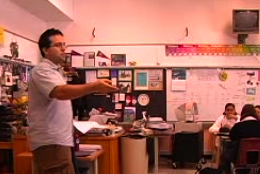

The Center for Mathematics Education for Latinas/os (CEMELA) is an NSF funded center for learning and teaching. As an inter-departmental center, CEMELA gave me the opportunity to collaborate with fellow researchers coming from a wide spectrum of expertise related to mathematics education.
CEMELA provided a wonderful opportunity for me to conduct qualitative research grounded in socio-cultural theory. I primarily worked on an after school math club where our research group studied student participation, mathematical agency, and mathematical identity over two semesters. The first semester we used a curriculum on cryptography where, in addition to our primary research focus, we examined how students would persevere or not while engaged in complex mathematical tasks. The second semester we used a curriculum of social justice, where the project and tasks were con-constructed with the students. During the second semester we also considered the impact of socially relevant and authentic tasks had on the students

Capturing Teacher Knowledge (CTK) is an IES funded grant that looks at the relationship between teacher knowledge, classroom instruction, and student gains.
The teacher knowledge is measured along 4 variables. As part of the study, I help refine the understandings of these variables to optimize our capacity to measure data we collect and treat as samples of teacher knowledge. Additionally, I design the student assessments on the topic that are used as a pre-test and a post-test to provide us with a measure of student gains.
Value-Added is an NSF funded grant that looks at studying the relationship .
As part of this project, I help develop the codes to measure instructional quality along several variables.