My research lies broadly in the area of Analysis with specific emphasis on problems related to Mathematical Physics.
The general goal is to develop new mathematical tools for the analysis of
many-body systems in quantum mechanics. A particular interest is to prove theorems that help in better
understanding of problems that combine effects of disorder and interactions for large quantum systems. My work centers on the
mathematical approaches to models that are relevant in quantum information theory and condensed matter physics.
The tools I use mostly come from operator theory, matrix analysis, probability, and spectral theory.
Aside from Mathematical Physics, I am interested in operations research/simulation, circle fitting, and Monte Carlo methods.
Publications / Preprints
Entanglement bounds in the XXZ quantum spin chain
(with C. Fischbacher and G. Stolz), Annales Henri Poincaré 21 (2020), 2327-2366.ArXiv|
Journal.
Abstract:
We consider the XXZ spin chain, characterized by an anisotropy parameter $\Delta>1$, and normalized such that the ground state energy is $0$ and the ground state given
by the all spins up state. The energies $E_K = K(1-1/\Delta)$, $K=1,2,\ldots$, can be interpreted as $K$-cluster break-up thresholds for down spin configurations.
We show that, for every $K$, the bipartite entanglement of all states with energy below the $(K+1)$-cluster break-up satisfies a logarithmically corrected (or enhanced)
area law. This generalizes a result by Beaud and Warzel, who considered energies in the droplet spectrum (i.e., below the 2-cluster break-up).
For general $K$, we find an upper logarithmic bound with pre-factor $2K-1$. We show that this constant is optimal in the Ising limit $\Delta=\infty$.
Beaud and Warzel also showed that after introducing a random field and disorder averaging the enhanced area law becomes a strict area law, again for states
in the droplet regime. For the Ising limit with random field, we show that this result does not extend beyond the droplet regime. Instead, we find states with
energies arbitrarily close to the $(K+1)$-cluster break-up whose entanglement satisfies a logarithmically growing lower bound with pre-factor $K-1$.
A class of two-dimensional AKLT models with a gap
(with M. Lemm, A. Lucia, B. Nachtergaele, and A. Young), Contemporary Mathematics, 741, 1-21 (2020).ArXiv |
Link.
Abstract:
The AKLT spin chain is the prototypical example of a frustration-free quantum spin system with a spectral gap above its ground state.
Affleck, Kennedy, Lieb, and Tasaki also conjectured that the two-dimensional version of their model on the hexagonal lattice exhibits
a spectral gap. In this paper, we introduce a family of variants of the two-dimensional AKLT model depending on a positive integer n,
which is defined by decorating the edges of the hexagonal lattice with one-dimensional AKLT spin chains of length $n$.
We prove that these decorated models are gapped for all $n\geq 3$.
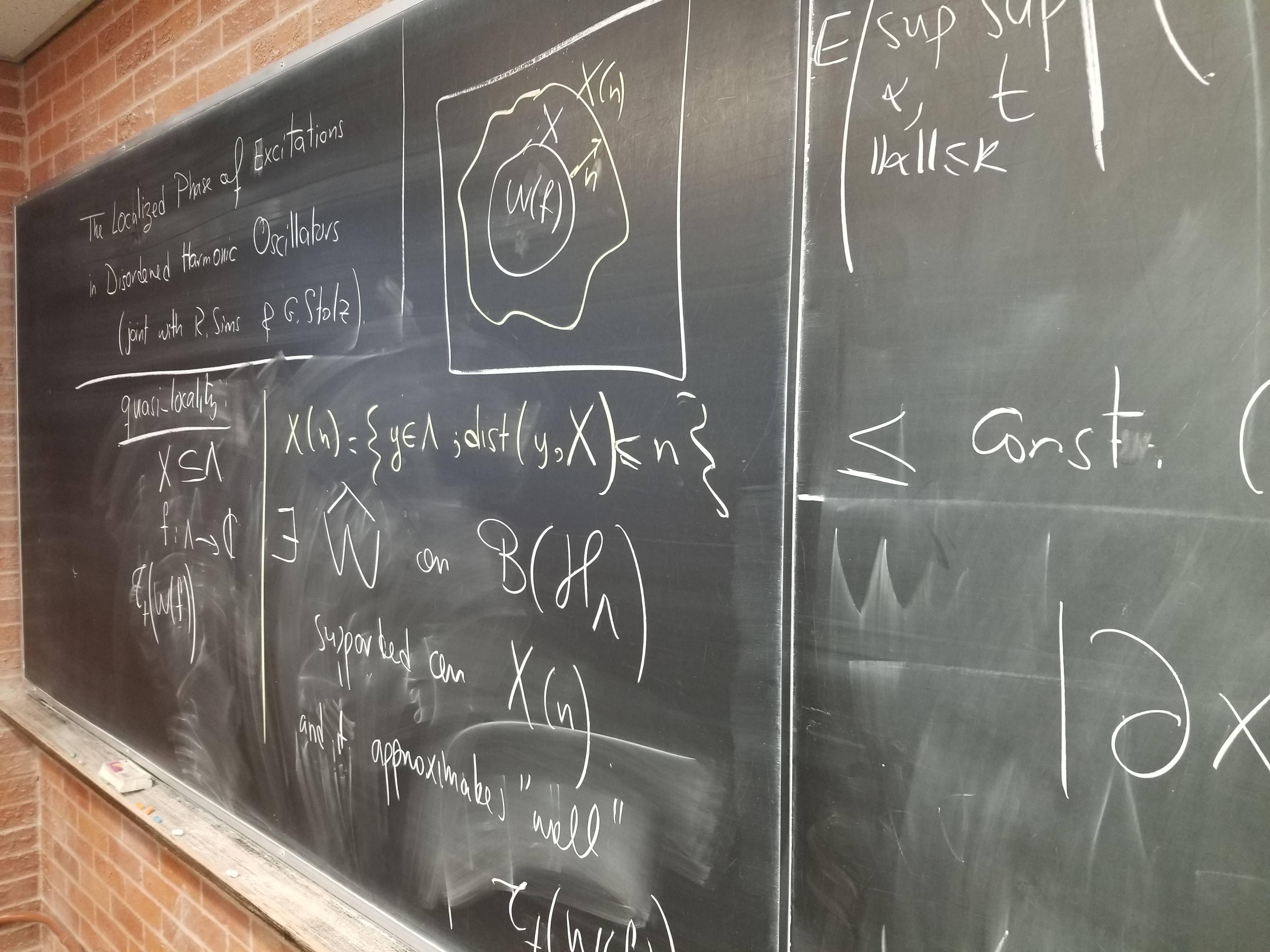
On the regime of localized excitations for disordered oscillator systems
(with R. Sims and G. Stolz), Letters in Mathematical Physics, 110, 1159-1189 (2020).arXiv |
Journal.
Abstract:
We study quantum oscillator lattice systems with disorder, in arbitrary dimension, requiring only partial localization of
the associated effective one-particle Hamiltonian. This leads to a many-body localized regime of excited states with
arbitrarily large energy density. We prove zero-velocity Lieb-Robinson bounds for the dynamics of Weyl operators as well
as for position and momentum operators restricted to this regime. Dynamical localization is also shown in the form of
quasi-locality of the time evolution of local Weyl operators and through exponential clustering of the dynamic correlations
of states with localized excitations.
Entanglement of a class of non-Gaussian states in disordered harmonic oscillator systems. Journal of Mathematical Physics 59, 031904 (2018)arXiv |
Journal.
Note: This paper has been chosen to be in the Editor's Pick collection.
Abstract:
For disordered harmonic oscillator systems over the $d$-dimensional lattice, we consider the problem
of finding the bipartite entanglement of the uniform ensemble of the energy eigenstates associated with
a particular number of modes. Such ensemble defines a class of mixed, non-Gaussian entangled states that
are labeled, by the energy of the system, in an increasing order. We develop a novel approach to find
the exact logarithmic negativity of this class of states. We also prove entanglement bounds and
demonstrate that the low energy states follow an area law.
Correlations in disordered quantum harmonic oscillator systems: The effects of excitations and
quantum quenches (with R. Sims and G. Stolz), Contemporary Mathematics, 717, 31-47 (2018).arXiv |
Link.
Abstract:
We prove spatial decay estimates on disorder-averaged position-momentum correlations in
a gapless class of random oscillator models. First, we prove a decay estimate on
dynamic correlations for general eigenstates with a bound that depends on the
magnitude of the maximally excited mode. Then, we consider the situation of a quantum quench.
We prove that the full time-evolution of an initially chosen (uncorrelated) product state
has disorder-averaged correlations which decay exponentially in space, uniformly in time.
Localization Properties of the Disordered XY Spin Chain
A review of mathematical results with an eye toward Many-Body Localization (with B. Nachtergaele, R. Sims, and G. Stolz), Ann. der Phys. (Berlin) 529, 1600280 (2017)arXiv |
Journal.
Abstract: We review several aspects of Many-Body Localization like
properties exhibited by the disordered XY chains: localization properties of the energy eigenstates and
thermal states, propagation bounds of Lieb-Robinson type, decay of correlation functions, absence of particle transport, bounds on the bipartite entanglement,
and bounded entanglement growth under the dynamics. We also prove new results on the absence of energy transport and Fock space localization. All these properties
are made accessible to mathematical analysis due to the exact mapping of the XY chain to a system of quasi-free fermions given by the Jordan-Wigner transformation.
Motivated by these results we discuss conjectured properties of more general disordered quantum spin and other systems as possible directions for
future mathematical research.
Dynamical entanglement of disordered quantum XY chains (with B. Nachtergaele, R. Sims, and G. Stolz), Letters in Mathematical Physics
106(5), 649-674, 2016.
ArXiv |
Journal.
Abstract: We consider the dynamics of the quantum XY chain with disorder under the general assumption that the expectation
of the eigenfunction correlator of the associated one-particle Hamiltonian satisfies a decay estimate typical of Anderson localization.
We show that, starting from a broad class of product initial states, entanglement remains bounded for all times. For the XX chain,
we also derive bounds on the particle transport which, in particular, show that the density profile of initial states that consist of fully
occupied and empty intervals, only have significant dynamics near the edges of those intervals, uniformly for all times.
A uniform area law for the entanglement of eigenstates in the disordered XY chain (with G. Stolz), Journal of Mathematical Physics,
56, 121901, 2015. ArXiv |
Journal.
Abstract: We consider the isotropic or anisotropic XY spin chain in the presence of a transversal random magnetic field, with parameters given by random variables.
It is shown that eigenfunction correlator localization of the corresponding effective one-particle Hamiltonian implies a uniform area law bound in expectation for
the bipartite entanglement entropy of all eigenstates of the XY chain, i.e. a form of many-body localization at all energies.
Here entanglement with respect to arbitrary connected subchains of the chain can be considered. Applications where the required eigenfunction correlator bounds
are known include the isotropic XY chain in random field as well as the anisotropic chain in strong or strongly disordered random field.
Fast and numerically stable circle fit (with N. Chernov), Journal of Mathematical Imaging and Vision , 49 (2), 289-295, June 2014.
ArXiv |
Journal.
Abstract: We develop a new algorithm for fitting circles that does not have drawbacks commonly found in existing circle fits.
Our fit achieves ultimate accuracy (to machine precision), avoids divergence, and is numerically stable even when fitting circles get arbitrary large.
Lastly, our algorithm takes less than 10 iterations to converge, on average.
An adaptive Monte Carlo integration algorithm with general division approach (with M. Alrefaei), Mathematics and Computers in Simulation, 79 (1), 49-59 , 2008.
Journal.
Abstract: We propose an adaptive Monte Carlo algorithm for estimating multidimensional integrals
over a hyper-rectangular region. The algorithm uses iteratively the idea of separating the
domain of integration into subregions. The proposed algorithm can be applied directly to
estimate the integral using an efficient way of storage. We test the algorithm for estimating
the value of a 30-dimensional integral using a two-division approach. The numerical results
show that the proposed algorithm gives better results than using one-division approach.
Two sequential algorithms for selecting one of the best simulated systems (with M. Alrefaei), WSEAS Transactions on Systems. 3: 2517-2522, 2004.
pdf.
Abstract: We consider the problem of selecting one of the best simulated systems when the
number of alternatives is large. We propose two sequential algorithms for selecting a good
enough simulated system based on the idea of ordinal optimization that focuses on ordinal
rather the cardinal of the competent systems. In the first algorithm, we use the idea of ordinal
optimization together with the Ranking and Selection procedure. In the second algorithm, we
use the ordinal optimization with the optimal computing budget allocation algorithm.
Theses
Entanglement in disordered quantum XY chains, PhD Thesis, University of Alabama at Birmingham 2016. pdf
Integration using Monte Carlo methods, Masters Thesis, Jordan University of Science and Technology 2005. pdf

subregions. The proposed algorithm can be applied directly to estimate the integral using an efficient way of storage. We test the algorithm for estimating the value of a 30-dimensional integral using a two-division approach. The numerical results show that the proposed algorithm gives better results than using one-division approach.