I work broadly on problems related to integrable systems theory, that includes different aspects of the study of solutions of nonlinear partial differential equations, asymptotic methods for solving Riemann-Hilbert problems, orthogonal polynomials, random matrix theory, random growth processes, non-intersecting random walks, and approximation theory.
Below is a summary of some of the work I am currently doing as well as a selection of some of my older work. You can click any of the links below to read more.
1. Semi-classical (zero dispersion) asymptotic behavior of nonlinear waves
Applications of orthogonal polynomials to random matrix theory, probability and random growth processes.
A complete matching M of [2n] elements is a partition of 2n into precisely n pairs,
and thus is naturally isomorphic to a fixed-point free involution of length 2n. A simple combinatorial argument shows that there are exactly (2n-1)!! such matching of 2n. Associated with any matching M are maximal nesting and crossing numbers as introduced by [Stanley et al], which loosely can be thought of as the largest number of intersecting or nested paths in a figure like the one above, who made various connections between these numbers and others of combinatorial interest. In particular, the maximal crossing and nesting numbers are individually both related to the longest decreasing subsequence of the corresponding fixed point free involution. From this it was shown by [Stanley et al] that for a random matching selected with uniform probability from the set of all complete matching of [2n] the fluctuations of the maximal crossing and nesting numbers from their mean are asymptotically governed by the Tracy-Widom GOE distribution for n >> 1. Moreover, they showed that the joint distribution of the crossing and nesting numbers of these matchings can be expressed in terms of a certain determinant.
In joint work with Jinho Baik, we proved that in the large n limit the limiting distribution of the joint distribution is asymptotically independent and calculated explicitly the first correction to the limiting distribution for finite Poissonized random matchings. Additionally we showed that the marginal distributions of the crossing and nesting numbers converge to the Gaussian Orthogonal (GOE) Tracy-Widom distribution and compute their explicit first corrections in the Poissonized case as well.

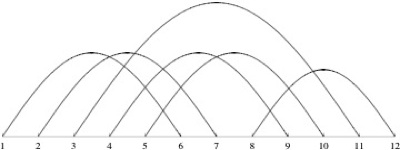
A complete matching of [12]
Collaborators
Jinho Baik
Michael Borghese
Robert Buckingham
Scipio Cuccagna
Joe Gibney
Ken McLaughlin
Peter Miller
Peter Perry
Kyle Pounder
Catherine Sulem
Density plot of the square modulus of the solution of the small dispersion focusing NLS equation for initial data u(x,0) = 1 for |x|<25/33 and u(x,0) = 0 for |x| > 25/33. Figure courtesy of Khamis, El, and Tovbis,

Soliton Stability and the Soliton Resolution Conjecture
In linear dispersive systems, dispersion has the effect of making waves with different wavenumbers travel at different velocities, the effect of which is that solutions typically decay, radiating their mass off to infinity as can be shown representing the solution as a Fourier integral and applying steepest descent / stationary phase analysis. In nonlinear waves, the nonlinear effects can have a balancing effect so that the system admits special localized travelling wave solutions called solitons. These solutions do not decay in time, they persist, and what is more they interact `like particles' in that their shapes and characteristics are not changed by their interaction, though they may aquire a phase shifts or other small changes to their free parameters. The soliton resolution conjecture is the widely held belief that for `generic' initial data the solution of any nonlinear dispersive evolution equation which admits soliton solutions will resolve at long times into a train of solitons plus a radiating error term.
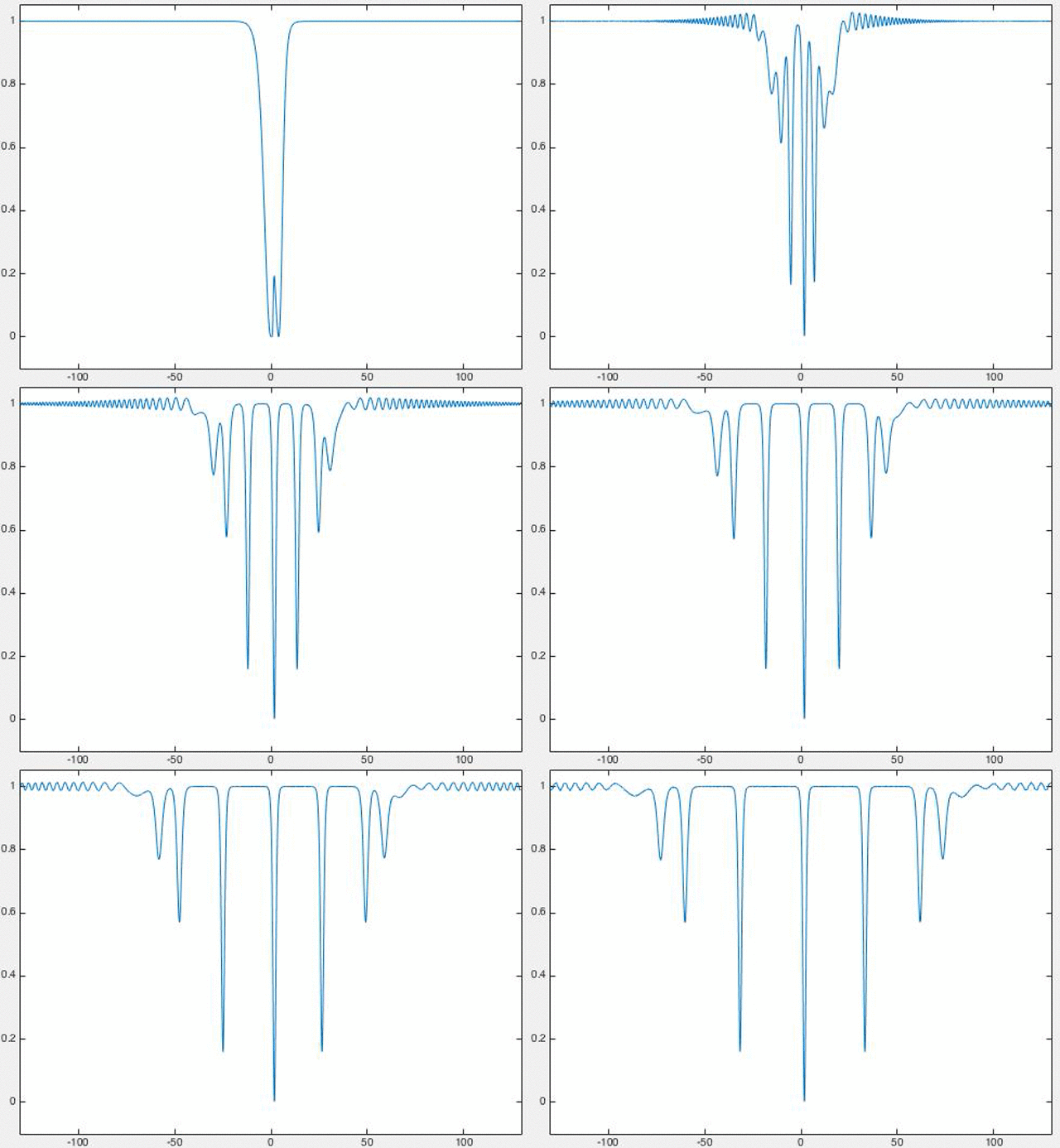
The animation at the top my home page gives an example of soliton resolution for the defocusing NLS equation on a nonzero background. The initial data resolves into a train of seven solitions plus oscillations which decay as time increases.
The soliton resolution conjecture is very vague. In particular what does `generic' initial data mean? It turns out that it typically cannot be characterized by the usual function spaces norms, which makes quantitative analysis of the conjecture difficult by classical PDE methods. There have been some partial results, but this is still a very open question and an active area of research.
I, with collaborators, have recently been using the inverse scattering machinery to precisely study the long time behavior of solutions to certian integrable nonlinear waves, which allows us to establish soliton resolution. With Scipio Cuccagna, I established soliton resolution for the defocusing NLS equation on constant modulus backgrounds, our results also establish the asymptotic stability of the multi (dark) soliton solution of defocusing NLS. Following this I worked with a graduate student Michael Borghese to establish soliton resolution for the focusing NLS equation. Our analysis uses the DBAR generalization of the steepest descent method for oscillatory Riemann-Hilbert problems which allows us to avoid certain messy details and sharpens the error estimates that are possible using the classical treatment.
This is an exciting direction of research with many good open problems to attack, and a good way for an interested graduate student to get their feet wet learning the methods of inverse scattering.
Uniform asymptotic expansions of Taylor polynomials of entire functions: an application to analytic number theory
If f is an entire function then it's Taylor polynomials converge in the whole complex plane. The simplest case, of course, is the exponential function. But exp(z) has no zeros, so a natural question to ask is: What happens to the roots of its Taylor polynomials? The simple answer is that the zeros must approach infinity, but how fast? and in what direction? Szego was the first to investigate these questions carefully and showed that, appropriately rescaled, the zeros of the Taylor polynomials of exp(z) accumulate along a fixed closed curve and that the limiting density of zeros is everywhere nonzero along this curve. Later work in this direction has refined the asymptotic description of these zeros and extended Szego's results to sin and cosine.
Using the contour integral representation
for the Taylor polynomials we utilize steepest descent analysis and Riemann-Hilbert techniques learned in the analysis of integrable systems to derive a uniform asymptotic expansion of the Taylor polynomials valid in the entire complex plane. This method is general and allows one to study very general functions. Together with Ken McLaughlin, we used this method to study the zeros of the Riemann xi function. Our uniform approximation results allow us to establish Riemann-Von Mangoldt type results for the Taylor polynomials of xi as well as a larger class of L-functions.

Density plot of the evolution of a soliton ensemble of the three wave resonant interaction (TWRI) equations. In the numerics, only the outer wave chanels (red and green waves) are nonzero; their interaction excites the middle (yellow) channel. During the interaction their appers to be a trasition to two phase oscillations.

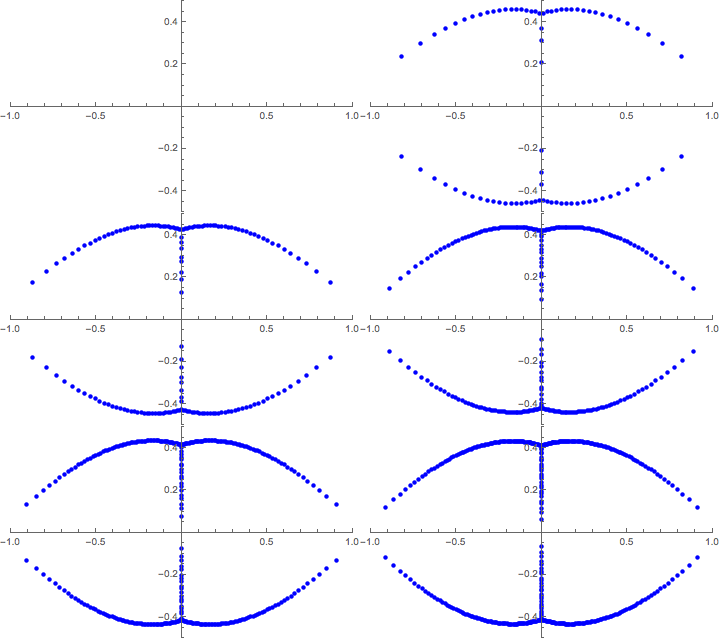
The rescaled zeros of the Taylor polynomials of the Riemann xi function for each degree up to 200. The spurious zeros accuulate along a fixed curve in the plane. Those zeros inside the accumulation curve approach true zeros of the xi function at an exponential rate.
Semi-classical (zero dispersion) asymptotic behavior of nonlinear waves
One of my principle interest in the study of nonlinear waves has been the asymptotic description of solutions in the small dispersion limit. Physically, this corresponds to a regime in which the length scale set by initial data is much longer than the natural wavelength of the oscillatory solutions set by the physical parameters of the system. This sort of situation is often of practical importance; it arrises in the study of light propagation in optical fiber, Bose-Einstein condensates, as well as problems in hydrodynamics.
Solutions to these types of equations typically exhibit regions of space time with rapid, quasi-periodic multiphased oscillations whose properties slowly change (or modulate, as it is referred to in the literature) as one moves through the region. A solution may have several such regions of rapid oscillations each with its own distinct character. Furthermore, as the dispersion becomes increasingly smaller, the transitions between these regions become increasingly sharp, resolving in the zero dispersion limit into breaking curves, sometimes called nonlinear caustics, across which the solution has a sharp phase-transition. A fundamental question in this line of research is to understand the nature of the oscillations in each region of space-time as well understand where and when these breaking curve will develop.
One can sometimes study the limiting zero dispersion systems to gain insight into the behavior of small dispersion solutions. This is very effective for hyperbolic systems in which where the limiting problem is well posed. However, for many systems, like focusing NLS, the zero dispersion limits are of elliptic type and thus ill-posed. In such a case, the small dispersion limit is necessarily requires delicate analysis. Whitham modulation theory can be used to derive approximate solutions but by its very nature as an averaging process it introduces errors which it cannot estimate. I use the inverse scattering transform (IST) to derive rigorous asmyptotic expansions with precise error estimates. In the semi-classical limit this often involves studying the spectra of operators with many eigenvalues and inverse problems which are very stiff but which can be rigorously analyzed using the nonlinear steepest descent method introduced by Deift and Zhou.
In my thesis work we gave the first rigorous description of the small dispersion limit for (this) non-analytic initial data. The figure to the right shows the small dispersion behavior of the focusing nonlinear Schrödinger equation for barrier initial data. The jump discontinuities are regularized by rapid one phase oscillations which propagate into the support of the initial data, their collision instigates higher order oscillations. My current work in this direction, with Alexander Tovbis, seeks to show that at large times there is an infinite sequence of breaking curves across which the solution has a strictly increasing sequence of phases. This will be a first example of such phenomenon.
WIth Peter Miller and Robbie Buckingham I am also working on describing the zero dispersion limit of the three wave resonant interaction (TWRI) equations. This is a coupled system of three nonlinear oscillators. Mathematically, this is a challenging problem because the Lax pair operators associated with system are higher order (3x3) which significantly complicates the analysis. Our numerical simulations suggest that many of the same phenomena that arrise in lower order dispersive systems are also present here, but the mechanism for their occurance is necessarily different as the TWRI equations are dispersionless.
Numerical simulation of defocusing NLS. The initial profile resolves into a train of solitons plus a decaying radiation term