TEACHING
Fall 2012-Spring 2013
G-TEAMS at Peter Howell Elementary
This work is part of an NSF GK-12 program at the University of Arizona.
(Link: G-TEAMS)
I worked at Peter Howell Elementary School, in Mrs. Hunley's 4th grade and Mrs. Clements' 5th grade classes.
(Link to G-TEAMS profile)Resources

Links
- Math Stars Newsletter (Grades 1-8), Public Schools of North Carolina
- NRICH Project--enriching mathematics, activities and problems
- Math Circle Presentations and Problems, University of Waterloo
- Math Top 10, problems for grades 1-7
Open Ended Math Problems/Logic Problems
Problem-a-Palooza!
One of my favorite parts of working at Howell was facilitating biweekly problem solving parties called Problem-a-Palooza! This is an excellent way to create a fun environment for students where they can enjoy mathematics. Students are presented with a set of 4-6 varied problems such as logic problems, classical problems, or curriculum-based challenge problems. The problems are designed to have varied levels--at least one problem should be accessible to all students, but the problems should be sufficiently challenging that no student finishes all of the problems in the allotted time. Students may solve any or all of the problems in any order, but they must write up a solution for each problem--in only 30 minutes! The problem solving is fierce. A complete solution earns a ticket in a drawing to win valuable prizes.
Problem-a-Palooza! is a natural avenue for the Common Core K-12 Mathematical Practices: students must "make sense of problems and persevere in solving them" as well as "construct viable arguments". Problem sets for both grade levels as well as a problem solving rubric are available under the resources section.
Project Based Learning
I also had the opportunity to work with both classes to develop extended projects. Project based learning greatly increases student engagement, because it facilitates students taking responsibility for their own learning. By giving the students freedom in how they approach the subject and express their findings, an instructor can create an environment where students feel personally invested in the project. Project based learning also easily lends itself to cross-curricular integration and real-world applications.
With fifth grade, we worked on an Original Soda Flavors project, which combined math, science, and persuasive writing. Students created their own soda recipes, conducted market research, and 'mass produced' their soda using proportional reasoning. They finished off the project by creating product packaging and filming commercials. We presented this work at the ITSP Conference in Boston. The ''Recipe for an Engaged Classroom'' presentation is available below.
In fourth grade, we ran a month-long stock market project to combine math with economics. Every Tuesday and Thursday, student teams of three followed their chosen stock from a list of kid-friendly stocks: Apple, Coca-Cola, Disney, Facebook, Hershey's, and McDonald's. The students learned about the stock exchange and practiced buying and selling stock with manipulatives. They also learned why companies sell stock (to raise money to buy new supplies, like tables or a computer server) and why people sell stock (to try to make money). The teams were responsible for graphing the value of 100 shares and trying to figure out why their stock value went up or down over the course of the month. (Link to Project Inspiration: Victor Piercey.) The stock market project will be published in MTMS, citation below.
The other project we implemented was the Fourth Grade Design Project. Students either designed a new playground, created a new school meal, or picked a new animal for Reid Park Zoo and designed its enclosure. Teams of three students had to interview an expert, survey other students, perform online research, create a budget, make a graphical representation of their final design, and present their results to the class. Some groups even got to go on a field trip to the zoo to interview a zookeeper! These projects combine math and writing with real-world applications. Project files are available under the resources section.
All of the project-based learning opportunities were presented at the G-TEAMS Summer Institute and the Heatwaves Summer Institute in June 2013. The ''Making Math Stick: Teaching Through Project Based Learning'' presentation is available below.
Publication
A Tale of Two Stock Markets
Real-world data bring economics to life by combining mathematics and language arts and promoting financial literacy.
 |
Introducing the stock market to students during math class makes both economics and mathematics more meaningful, teaches mathematical concepts using real-world data, and fits in well with the Common Core State Standards for Mathematics (CCSSM) (CCSSI 2010b). Furthermore, fluctuations in the stock market can lead to valuable student insight about change in function values over time. Armstrong, Michelle Hine, Piercey, V.I., and Greene-Hunley, S. (2015). "A Tale of Two Stock Markets." Mathematics Teaching in the Middle School, 20(9), 522-530. (Link to NCTM) |
Presentations
Making Math Stick: Teaching Through Project Based Learning
2013 G-TEAMS Summer Institute, Tucson, AZ; June 3, 2013
Heatwaves Summer Institute, Tucson, AZ; June 18, 2013
Explore three different projects that were implemented in 4th and 5th grade. Project based learning provides authentic student experiences that place math in context. These learner-driven, inquiry-based opportunities combine math, science, literacy, art, economics and more. Through Original Soda Flavors, Fourth Grade Design Project, and the Stock Market Project, students encountered sophisticated concepts and developed higher order thinking skills.
 |
Presentation: Making Math Stick |
Collaboration with Project Based Learning: Recipe for an Engaged Classroom
ITSP Conference, Boston, MA; February 13, 2013
This session focused on the collaboration between a University of Arizona math graduate student and elementary school teachers in planning and implementing STEAM (STEM plus Arts)-focused Project Based Learning opportunities and problem solving parties for 4th/5th grade students. Learn how projects were developed and how connections between math, science, literacy, and the arts were created and sustained.
| |
Presentation: Recipe for an Engaged Classroom |
Journal
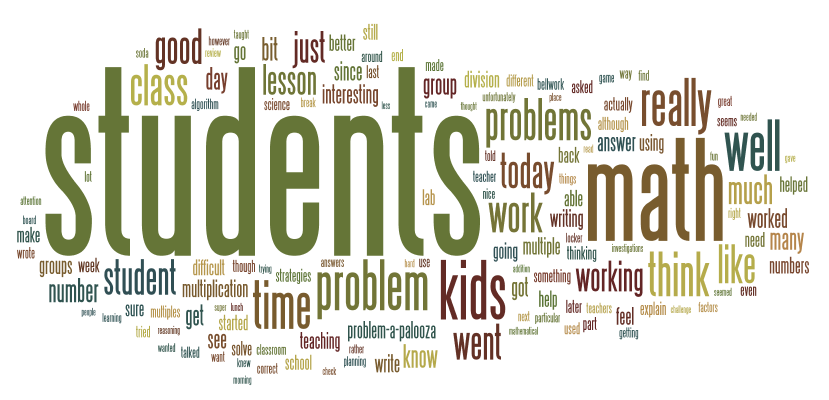
As part of the G-TEAMS experience, I kept a journal of my classroom time. Here's a wordle of my journal entries. (Reference: www.wordle.net)