
Fellow Profile: Shane Passon
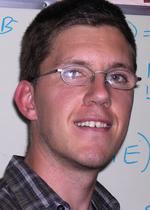
- G-TEAMS Cohort: 2011-12
- Graduate Program: Mathematics
- Teacher Partners: Kathy Anderson
- School: Utterback Middle School
- Grade level: 8
- Topics: Mathematics
"Mathematics is a game played according to certain rules with meaningless marks on paper." David Hilbert
"For the things of this world cannot be made known without a knowledge of mathematics." Roger Bacon
Research Interests
Shane's research interest: I study different families of random walks. The family I am currently working with are called self avoiding walks. If we considered a large city where all the streets run North-South and East-West. Further assume all the streets go entirely through the city so it forms a grid. Then pick two intersections, A and B. The set of self avoiding walks are all the paths from A to B where you never go to the same intersection twice. There are several properties which are interesting to explore in these models. One of the most interesting cases is what happens as we let the spacing in our grid go to zero. We should get some continuous analogue to the discrete process. There is evidence, but no proof, that the continuous version is a special process called Schramm-Loewvner evolution. My research involves looking at connection between the continuous process and the discrete process
Classroom Activities
Shane has been working with 8th grade teacher Kathy Anderson at Utterback Middle School. Shane's goals for his classroom involvement include:
- Create an enviroment where students can think critically about the mechanics of mathematics.
- Focus on concept comprehension and linking the methods students use to why those methods work.
- Show relationships between the different topics that students are learning in mathematics.
Lessons Learned
As part of my preparation I found some of the most popular fiction for the 13-14 year old age group and started reading. After reading three books that varied in topic, genre, and style I found they had one property in common; the protagonist hated math. Mathematics was always presented as a boring repetative subject which only socially awkward students would excel at.
To my horror, I found this opinion was the dominant one in the classroom. Students say "I am bad at math" with something approaching pride. When students have shown aptitude in the subject, other students have called them 'nerd' or other similar term. This has created an environment where even talented students are hesitant to participate.
Another lesson that it appears I have to learn again and again is one involving pacing and time management. We have rather long classes and designing exercises which are within the productive attention span is difficult. Kathy and I work together to generate projects, activities and worksheets for the students to work on. Most of the time make the exercises to long and Kathy decides that most exercises could use more explanation or a picture to clarify the goal.
Teaching Materials
Over the course of the years we looked for different ways to make practicing the mechanics of math more fun. One of our successes was many variations of bingo. We made special bingo cards. Then we would call out expression, equations, inequalities, or other information which allowed the students to generate the number.
- Expressions bingo focused on using the appropriate order of operations and using arithmetic rules to make computations in a more efficient manner.
- Linear equations bingo focused on teaching the students to use a additive and multiplicative rules of equalities to solve equalities.
- Pythagorean bingo: Made the students more familiar with the Pythagorean Theorem and the distance formula. It helped develop the concept of a root and the square root function.
Another tool which we used were cypher puzzles. These were mathematical puzzles whose answer provided the key to deciphering a coded message. Again a python script was used to generate the worksheets. These were less successful for two reasons. The first few times I tried them, the math problems were a little above the students' current level of proficiency and they were prone to getting incorrect answers which made the puzzle unsolvable. Also the initial version was large and required a large amount of work before any progress towards the solution was seen. Again a couple of examples may be found below.
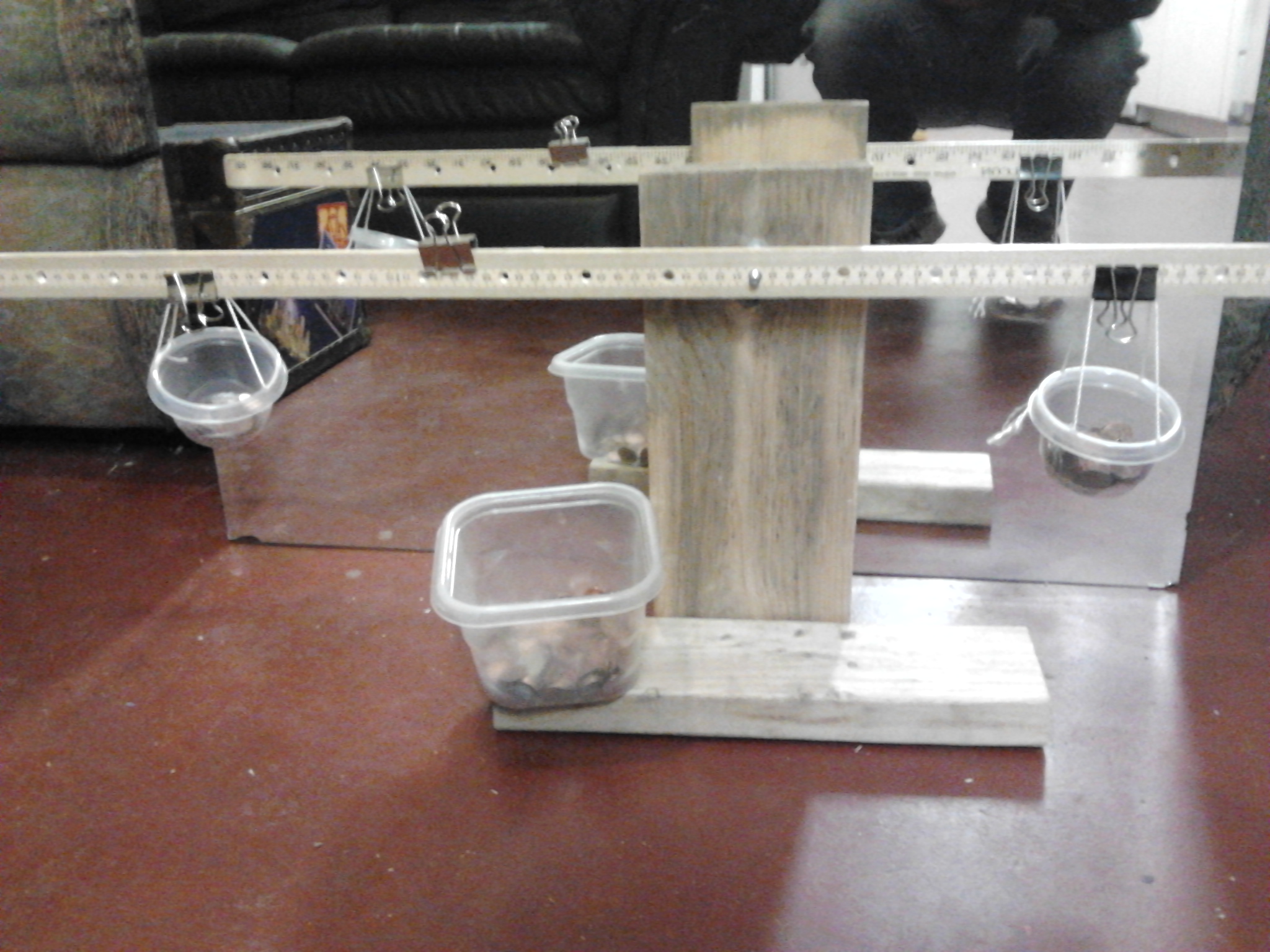
Lines, linear equations and linear models were particularly emphasized this year. We incorporated scientific models and used simple levers to explore linear models.
Later in the year we did another set of experiments with pendulums. This one was useful because it involved radicals. We also learned a little more about measurement and significant digits.
- Experiments and mini-labs:
- Plinko and the binomial distribution
- Pendulum lab
- Torque: Levers, Linear and inverse relationships
- Directed graphs and the NFL
- Line art project
- Bingo:
- Cypher puzzles: