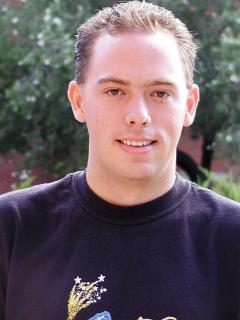
Fellow Profile: David Love
- G-TEAMS Cohort: 2010-11
- Graduate Program: Applied Mathematics
- Teacher Parners: Roz Wolfe
- School: City High School
- Grade level: 9-12
- Topics: Algebra II, Trigonomety, Pre-Calculus and Statistics
"Mathematics is a human enterprise, wherein we do our best to make sense of the world around us. I believe that the cultural context of mathematical discoveries, and their evolution since original discovery, can provide important insights into how we think of and teach mathematics."
Research Interests
David’s research is in stochastic programming, which attempts to find solutions to a variety a decision-making problems when important information pertaining to the problem is uncertain or unknown. Many of these problems fall broadly within the field of logistics, for example, studying how an airline can most efficiently use its supply of airplanes and ground services to move the greatest number of people. Practitioners are also turning their attention to the optimal use of the basic resources of civilization. How should a city, for example, plan and build its water system, both for current efficiency, while still planning for (currently unknown) future growth?
Classroom Activities
David has been working with Roz Wolfe at City High School. David and Roz have students in all high-school grade levels, but most are Juniors and Seniors. City High School is a charter school that focuses on engaging students with material that relates directly to the Tucson culture. With this in mind, David’s goals for his classroom involvement include:
- teaching mathematics in the cultural context within which it was originally discovered;
- teaching students to communicate the logic of their thought, rather than finding the "correct answer;"
- showing students some of the many ways that mathematics contradicts everyday intuition, and makes us more informed about the world;
- learning to communicate effectively with a non-mathematical audience;
Lessons Learned
One of the first things that I noticed when coming into the classroom was the difficulty that many students have with "basic" tasks that previous courses should have required them to master. Everyone who's been involved in mathematics education, or even just taken a math class, knows that many people have great difficulties with fractions. I have learned the extent to which educators must work to clear up the accumulated misconceptions of a student's eduction history.
One thing that I learned from my partner Roz is the value of fostering some independence from the teacher. My natural inclination in teaching is to make myself as available as possible to the students, whenever they have a question that needs to be discussed. Unfortunately, the practical result of this is that students will immediately consult the teacher when they have any sort of uncertainty, rather than trying to think through it themselves, or discussing it with each other. Roz gave them instructions on how they can help themselves (i.e., reread the question, check the text, consult with another student) before coming to us.
Most recently, I've been working to ensure that students have some measure of ownership of the work that they are doing. I'm trying to do this, especially in our statistics course, by having them apply everything that they're learning to a data set that they collected themselves. For the students who come up with their own idea of what to study, they can see how their predictions square with reality. Students are also given some example projects, if they don't have their own ideas on what to study. I think this method produces more interest from the students than doing the same exercises over and over.
Teaching Materials
- Comparison of Brain and Body size in animals. Use of logarithmic scales as a way of visualizing data.
- Real vs. Fraudulent Random Numbers. Using real or imaginary coin flips to show how to detect fraud in some data.
- Introductory Statistics Project. A project to introduce students to single variable descriptive statistics, to be done alongside lectures.