
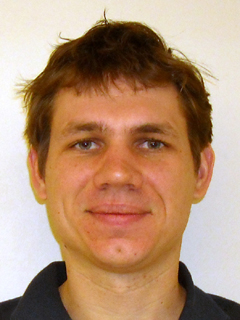
Fellow Profile: Colin Clark
- G-TEAMS Cohort: 2013-14
- Graduate Program: Applied Mathematics
- Teacher Partner: Jennifer Thompson
- School: Flowing Wells Junior High
- Grade level: 7-8
- Topics: Probability, Graph Theory, Finance
"In mathematics the art of asking questions is more valuable than solving problems."
- Georg Cantor
Research Interests
The geologic formations buried beneath the earth's surface have a profound effect on the pathways of groundwater flow. The percolating fluid is affected by both the geometry of nearby formations as well as the connectivity of the wider network. Since soils often show a high degree of spatial variability, exhaustive sampling is prohibitively expensive and consequently data sets are often either too sparse or too small. I overcome these difficulties by simulating flow through virtual samples which have been randomly generated to be representative of the original structure.
Classroom Activities
- Probability Games:
- Non-Transitive Dice produce a game of "rock-paper-scissors" with the rules hardwired into simple probabilities on three die. The faces of relabeled so that blue is expected to beat yellow, which is expected to beat pink, which in turn, is expected to beat blue.
- Counting through a pseudo-random list of numbers gives unexpected, yet inevitable convergence. At each turn, the student counts forward the number of steps given his/her position at the previous turn. Students must explain why all starting points converge to the same path.
- The unfinished game demonstrates that expected outcomes must be calculated by looking to the future, not the past. Head-to-head contests between students in a best-of-five winner-take-all coin-flip duel....unfortunately the coin is 'lost' when the score is 2-1 and students must decide if there is a logical way to share the spoils.
- Graph Theory Games:
- The Seven Bridges of Konigsberg provides a beautiful example of how a 300 year-old math is being used to model traffic flow, social media and industrial optimization.
- A stochastic SIR model for disease transmission can be simulated by watching an infectious 'zero' propagate through the class. Each student begins with a secret number and at each turn randomly pairs up with another student and multiply their secret numbers together to find his/her new secret number. Students recognize the initial exponential growth and must then explain the logistic profile near saturation. In subsequent games, students can suggest additional parameters such duration of illness, probability of recovery and possible immunity to model different diseases like chickenpox or the Zombie Apocalypse.
- The ___-Color Theorem forces students to distinguish between what they think and what they know. How many colors are required to paint the map of America?...and if you drew the map on a Mobius strip?
- Finance, Economics and the Stock Market:
- Money often seems to be the best place to assess a students number sense. Word problems involving investments provide and excellent setting for operations of signed numbers, critical analysis of 'deceptive graphs', and a real-world use of scientific notation.
- 'Buy Low, Sell High' So obvious in principle,...so hard in practice. Each student has invested a virtual $2000 in the stock market to learn basic priciples of investing, responsible habits for personal finance and the potential gain from thinking critically about current events.
- Elementary Game Theory... We really believe that analyzing the rules of human behavior through games like the 'Prisoner's Dilemma' and the 'Tragedy of the Commons' is within the grasp of many of the students and we look forward to engaging them at this level next semester.
Lessons Learned
Many of us love to do. This may be, in part, because we do 'doing' so well. We enthusiastically calculate and solve, and we love to explain what we already know. Thinking, on the other hand, can be foreign territory. Jen is teaching me to focus less on the doing, and to focus more on projecting an idea that needs to be digested, articulated, and questioned.
Teaching Materials
- Introductory Presentation (PDF)
- Class Notes and Lectures
- Non-Transitive Dice (PDF)
- Seven Bridges of Konigsberg (PDF)
- Four Color Theorem (PDF)