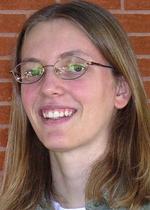
Fellow Profile: Chantel Blackburn
- G-TEAMS Cohort: 2009-10
- Graduate Program: Mathematics
- Teacher Partner: Janet Liston
- School: Cholla High Magnet School
- Grade level: 10-12
- Topics: Honors Intermediate Algebra, International Baccalaureate Standard Level, International Baccalaureate Studies Level
"I want to help cultivate mathematical thinking in students because when you learn to think carefully and logically in life you can anticipate problems and solutions."
Research Interests
Chantel completed her master’s thesis in the area of algebra (more specifically, modular group theory) in the spring of 2009. For her work she wrote a program using the programming language GAP (Groups, Algorithms, Programming) to determine the simple representation modules of a large number of finite simple groups. To do this work she utilized the character information for finite simple groups available in the Atlas of Group Representation. Her other research interests in mathematics include mathematical modeling in biology and the Hausdorff Metric Geometry.
Chantel is currently working toward her PhD in mathematics with an emphasis on mathematics education for her dissertation. Her mathematics education research interests include development and training in reasoning and problem solving, relationships between arithmetic skills and algebraic manipulation, and collaborations between mathematicians and mathematics educators. She is also interested in how the structure of the mass education system in the United States influences the ways in which mathematics is taught.
Classroom Activities
Chantel has been working with Janet Liston at Cholla High Magnet School. Janet’s classes this year are Honors Intermediate Algebra, junior and senior IB Studies and junior IB Standard level mathematics.
Chantel spends her time in the classroom:
- Teaching class lessons
- Introducing students to interesting mathematical applications
- Exposing students to computer programming languages and computer algebra systems
- Helping Janet guide students working on a major mathematics project (IB internal assessment)
- Observing a master teacher (Janet Liston)
- Learning techniques for introducing new topics to high school students and strategies for encouraging students to communicate mathematics verbally
Lessons Learned
One of the big lessons Chantel has learned in the process of bringing her research in algebra into the classroom is a new perspective on mathematical modeling. Typically, mathematical modeling is done using techniques from analysis and involves applications in physics, chemistry, and now more commonly, biology. Physics sometimes utilizes group structures in modeling but more commonly a major part of algebra, linear algebra, is used as a tool in mathematical modeling. However, over the course of the year Chantel’s perspective has changed to realize that algebraic structures (and their properties) are not as abstract as they first appear – they are actually models too. For example, the commutative group structure of the integers is a model of our everyday experience with quantity. Now she can see how even fields that are typically considered more abstract, like algebra or geometry, can be viewed in terms of how we use that field to model our experiences in the world.
When teaching mathematics and/or applications, it is never a good idea to assume that anything is obvious. What is obvious to the teacher may not be obvious to the students and vice versa. You must always be prepared to explain your reasoning or be willing to say “I don’t know” and have the desire to find out. Helping students realize this can help them with communicating mathematics verbally and in writing.
Teaching mathematics for conceptual understanding involves a careful balance between explicitly teaching a concept, following procedures, and revisiting conceptual ideas. Sometimes an idea can be overwhelming and the only way to get through the work is to memorize a scary formula. Once a student is more comfortably with the intimidating formulas, making sure to revisit the conceptual ideas can help the student make a more solid conceptual connection. For example, once students are comfortable with the formula for calculating the distance between two points in the plane, it is easier for students to grasp the formula conceptually when you revisit its relationship to the Pythagorean Theorem.
Teaching Materials
- Worksheets: Looking at patterns in mathematics and the importance of form (patterns as a set of directions) (algebra)
- Worksheets: Mayan and Greek number systems and square – an algebra project looking at mathematical notation (emphasizing choices and utility) and properties of the group of symmetries of the square (algebra)
- Mini Projects: Developing problem solving strategies to prepare for a larger independent project. Includes the “Towers of Hanoi” and the “Handshake Problem” (patterns and/or geometric series; systematic data collection/generation, quadratic regression and interpretation of results)
- Worksheets: Three questions about sundials. Why is the angle formed by the style (shadow casting edge of the gnomon) and the face equal to the latitude of the location of the dial? How do two methods of determining the angle of the hours lines (from noon) on a sundial relate to one another? Where does the trigonometric formula for determining the angle (from noon) on the face of a sundial come from? (geometry, trigonometry)
- Slides: Using Mathematics to Describe our World; Algebra, Geometry, Analysis (includes Geometry Applet) (algebra, geometry, analysis, mathematical modeling)
- Computer Program: Generating the Sierpinski triangle using chaos (MatLab) (probability, fractals)
- Monty Hall Simulator (windows executable written in C) (probability)
- Independence and Dependence Simulator: Excel spreadsheet simulating independent and dependent events, displays experimental probabilities, uses Chi Square to test for independence (probability, statistics)