Welcome to my research page Home
R link: http://www.r-project.org/
Benchmark Dose Information: http://www.epa.gov/ncea/bmds/about.html
Bootstrap scheme: http://en.wikipedia.org/wiki/Bootstrapping_%28statistics%29
A major component of quantitative risk assessment involves dose-response modeling.
Therein, an appropriate statistical model that approximately quantifies the relationship
between exposure level (dose) and response (adverse endpoint) is fit to
experimental data.
The objective is to estimate adverse risks encountered
in settings when the statistical model
is formally defined and developed. From this, statistical inferences on the risk are conducted.
The advantage of parametric models
is they can produce consistent result when the selected
model fits the dose-response
curve very well. The simplicity of knowing the expression of
these models allows for
the construction of a variety of lower confidence limits, based on the Wald approach.
However, if the true dose-response curve deviates significantly from a posited parametric
model, the result may perform poorly. Non-parametric methods are then needed.
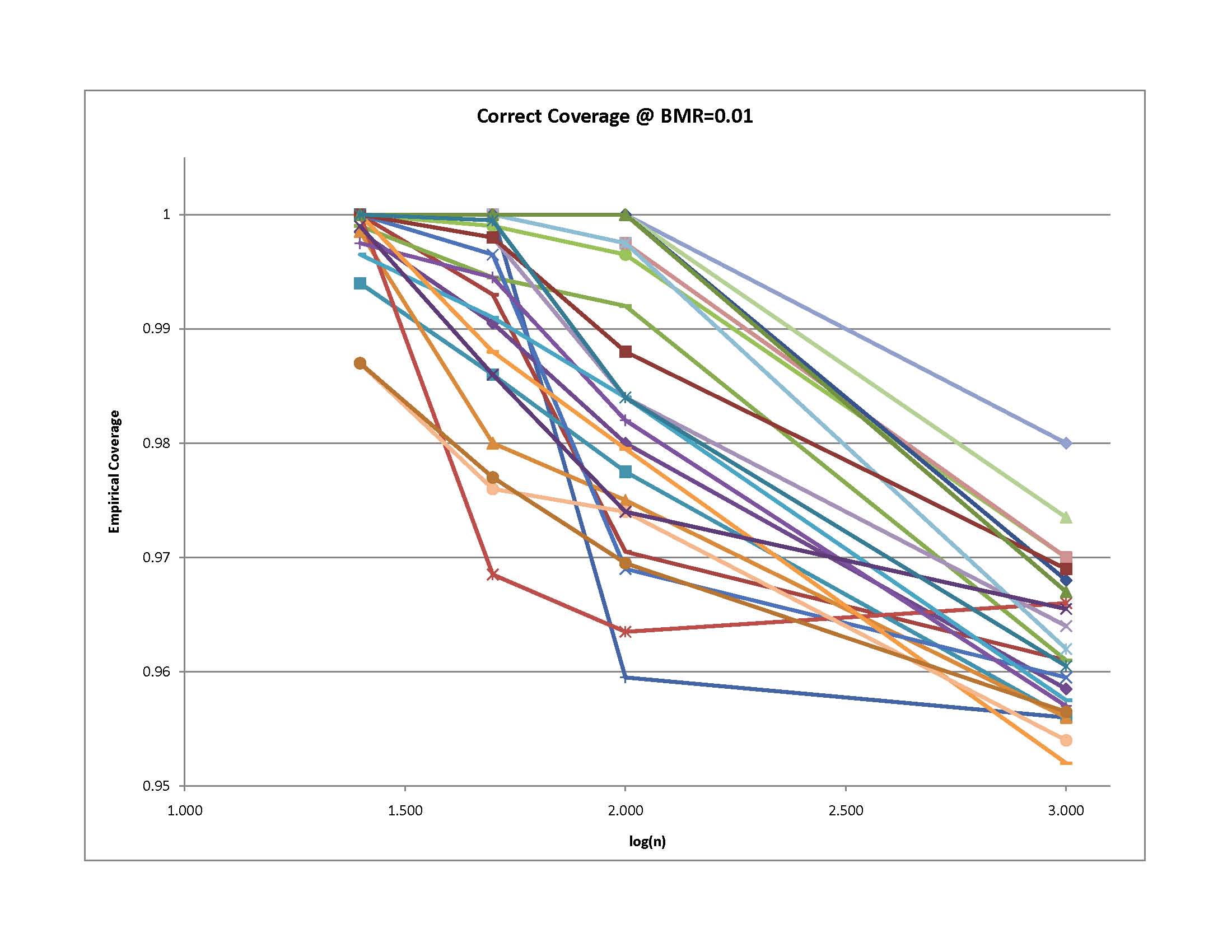
The percentile bootstrap method from linear splines with Pool Adjacent Violator
appeals to an asymptotic approximation, hence there is interest in assessing the small-sample
coverage properties of this method. These are addressed via Monte Carlo computer simulations.
We find that this method with four doses operates reasonably well at large sample sizes except
for the concave increasing dose-response curve. In practice, small sample sizes are more common,
therefore we turn to increasing the number of doses. We do see that, in general, the coverage
becomes better as the doses number increases.