|
Projects
Perelman's recent proof of the Poincare conjecture
(see http://en.wikipedia.org/wiki/Poincare_conjecture)
showed the power of deforming geometric spaces. We will look at a
number of problems related to deforming geometric spaces.
Warning: Some of the references below are elementary
and some are rather advanced. Do not be too scared that you cannot read
the papers, as you will have the opportunity to be "trained" using more
elementary texts, writings, or lectures.
Background requirements: As a minimal requirement, you
should
have a knowledge of basic linear algebra, multivariable calculus, and
differential equations. Any background in the areas mentioned below
is a plus, but not a requirement.
Some problems:
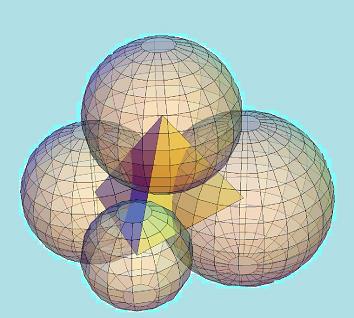
- Given a space constructed by gluing together Euclidean
triangles or tetrahedra, can we find a "best geometry" by varying the
lengths of edges. For instance, the best geometry on a tetrahedron is
one which has all equal edge lengths. But what about more complicated
structures? Is there a differential equation which can lead us to
canonical geometries in the way the Ricci flow solves the Poincare
conjecture? [G1] [G2] [CG] These questions are related to the problem
of finding circle packings which have a given adjacency pattern (see
also Ken Stephenson's Circle Packing site http://www.math.utk.edu/~kens).
[CL] [S]
- We will consider how to visualize complicated geometries.
What if the Earth were shaped like the surface of a doughnut? What if
it were even more complicated? If we could see across the universe,
what would we see? Some of these questions were addressed in E.
Abbott's classic book "Flatland" [A] (see also Flatland: the Movie, http://www.imdb.com/title/tt0814106/)
and J. Weeks' book "The Shape of Space" [W] (see also J. Weeks' website
http://www.geometrygames.org).
- Consider the group of translations of the Euclidean plane.
The set of vectors at the origin in the plane form a vector space, and
this vector space can be translated via the group action to vectors
based at any point. By defining an inner product to measure the length
of vectors and angles between vectors at the origin, one can measure
length and angle between vectors at any other point by
"translating" the inner product to any other point in the plane using
the group action. If one does this on a more complicted space (like the
sphere), the changing inner product reflects the geometry of the space
(for instance, "roundness" of the sphere). This inner product at each
point is called a Riemannian metric (see http://en.wikipedia.org/wiki/Riemannian_manifold).
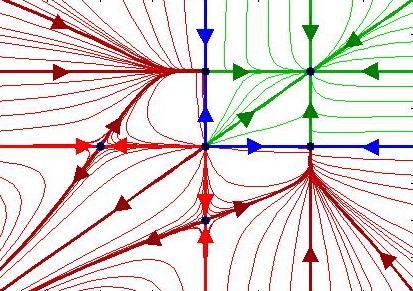
We will apply this idea to matrix groups such as the group of 2 x 2
real matrices with determinant equal to one, which have surprisingly
complicated geometries. We will be able to study dynamics of these
metrics under Ricci flow using basic analysis of dynamical systems as
in [GP].
References:
[A] E. Abbott. Flatland: A romance of many
dimensions. 1884. Reprinted in Dover.
[CG] B. Chow and D. Glickenstein. Semidiscrete
geometric flows of polygons. Amer. Math. Monthly 114 (2007), no. 4,
316--328.
[CL] B. Chow and F. Luo. Combinatorial Ricci flows
on surfaces. J. Differential Geom. 63 (2003), no. 1, 97--129.
[G1] D. Glickenstein. Geometric triangulations and
discrete Laplacians on manifolds. See http://arxiv.org/abs/math/0508188.
[G2] D. Glickenstein. Discrete conformal variations
and scalar curvature on piecewise flat two and three dimensional
manifolds. See http://arxiv.org/abs/0906.1560.
[GP] D. Glickenstein and T. Payne. Ricci flow on
three-dimensional, unimodular metric Lie algebras. See http://arxiv.org/abs/0909.0938.
[LGD] F. Luo, X. Gu, and J. Dai. Variational
principles for discrete surfaces. International Press, Somerville, MA,
2008.
[S] K. Stephenson. Introduction to circle packing:
The theory of discrete analytic functions. Cambridge University Press,
Cambridge, 2005.
[W] J. Weeks. The shape of space. Marcel Dekker,
Inc., New York, 1985.
|